Article prepared by: Dr. Izwaharyanie Ibrahim
Source: Advanced Functional Materials (2025)
A Smart Way to Watch Microalgae at Work
Microalgae are tiny, photosynthetic organisms that play a big role in balancing Earth’s carbon cycle. They convert carbon dioxide into oxygen and biomass, making them promising candidates for carbon fixation and renewable bio-energy production. But to use microalgae effectively, scientists must understand how they perform photosynthesis under different lighting and environmental conditions — and that’s no easy task.
Traditional monitoring techniques, such as dry-mass or oxygen measurements, are slow and indirect, often taking days or weeks to show results. This new study from Xiamen University Malaysia introduces a cutting-edge solution: using a Droplet Triboelectric Nanogenerator (D-TENG) to track photosynthetic activity in real time
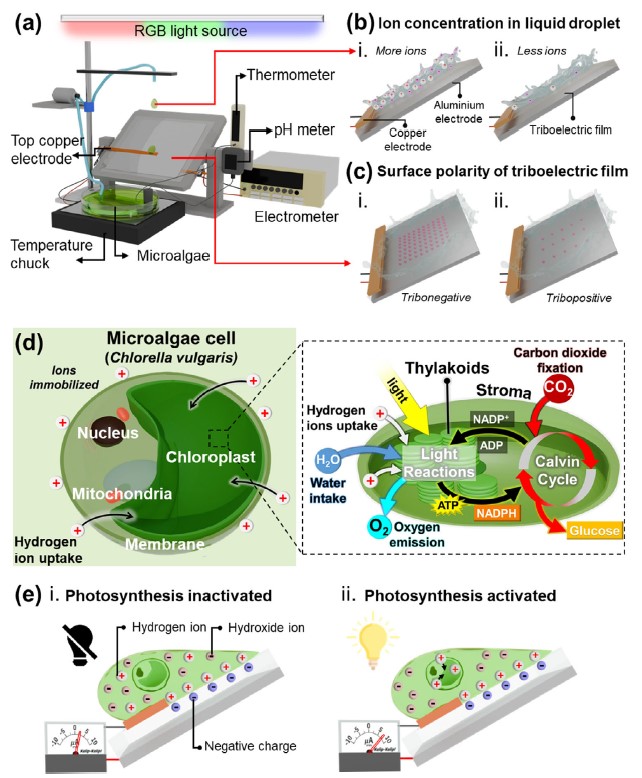
An overview of the study. Schematic illustrations of a) the laboratory-made experimental setup for the D-TENG measurements, b) varying the ion concentration of the water droplets, c) varying the tribopolarity of the polymer film of the D-TENG, d) schematic of microalgae cell with a close-up view on the stroma highlighting the light reactions and the Calvin cycle involved in photosynthesis, and e) comparison of ion behavior in the microalgae suspension under inactivated and activated photosynthetic conditions.
How It Works
The D-TENG device captures the electrical signals generated when tiny water droplets containing microalgae interact with a special polymer surface. These signals are sensitive to changes in ion concentration — which naturally occur during photosynthesis when microalgae absorb and release hydrogen and carbon ions.
By monitoring these charge variations, the system can instantly detect when microalgae are actively photosynthesizing, without disturbing the culture.
In other words, it “listens” to the electric whispers of the algae as they turn light into life.
Light, Temperature, and Photosynthesis
The researchers tested how the D-TENG responded under different light wavelengths — red, blue, and green — and at various light intensities and temperatures.
- Red and blue lights triggered strong electrical signals, showing that these wavelengths stimulate photosynthesis most effectively (matching the absorption spectrum of chlorophyll).
- The device even detected cyclic electrical patterns, reflecting the natural rhythm of microalgal metabolism as they switch between light and dark reactions.
- As temperature increased, the system revealed faster photosynthetic cycles, up to an optimal range around 25–30 °C before activity declined due to enzyme denaturation.
- At very high light intensities, the signals dropped — a sign of photoinhibition, where excessive light harms the photosynthetic machinery
.
Ready for Real-World Use
The D-TENG system performed reliably under natural sunlight, adapting to changing conditions such as cloudy or rainy weather. This proves it can be used outside the lab for real-world monitoring of algal ponds or photobioreactors, providing dynamic feedback for optimizing light exposure and growth conditions
Toward Smarter Carbon Fixation
This innovation represents a major step forward in environmental nanotechnology. By transforming triboelectric nanogenerators into biosensors, researchers can now observe the invisible — the pulse of photosynthesis itself — in real time.
Such insights could help scientists and industries design smarter algal cultivation systems for carbon capture, wastewater treatment, and sustainable bio-product development.
Reference
- https://advanced.onlinelibrary.wiley.com/doi/abs/10.1002/adfm.202514116
- https://pubs.acs.org/doi/10.1021/jacs.3c13674
- https://advanced.onlinelibrary.wiley.com/doi/10.1002/advs.202408718
- https://linkinghub.elsevier.com/retrieve/pii/S138589472501722X
- https://pubs.acs.org/doi/10.1021/acsami.4c17442
- https://www.sciencedirect.com/science/article/pii/S2949881324000192
- https://www.nature.com/articles/s41598-024-60823-y
- https://www.sciencedirect.com/science/article/pii/S2666386424000201
- https://pmc.ncbi.nlm.nih.gov/articles/PMC11219322/
- https://www.sciencedirect.com/science/article/abs/pii/S2211285524002672
- https://www.sciencedirect.com/science/article/pii/S2405844021026281
- https://pmc.ncbi.nlm.nih.gov/articles/PMC6999351/
- https://www.sciencedirect.com/science/article/abs/pii/S0176161721000316
- https://www.frontiersin.org/journals/marinescience/articles/10.3389/fmars.2019.00029/full
- https://pubmed.ncbi.nlm.nih.gov/8318516/
- https://www.pnas.org/doi/10.1073/pnas.1618922114
- https://www.frontiersin.org/journals/marinescience/articles/10.3389/fmars.2025.1568287/full
- https://www.tandfonline.com/doi/full/10.1080/09670262.2021.1885065
- https://www.mdpi.com/2076-3417/15/13/7324
- https://pmc.ncbi.nlm.nih.gov/articles/PMC7464137/
Date of Input: 21/10/2025 | Updated: 11/11/2025 | izwaharyanie
MEDIA SHARING