Article by: Nur Hidayahanum Hamid
Source: Universiti of Connecticut
A new model for carbon capture in low-oxygen aquatic environments, such as fish farms, could significantly mitigate climate change while enhancing sustainability in aquaculture industry, according to a study in Nature Food. Led by Mojtaba Fakhraee, an assistant professor of Earth sciences, and Noah Planavsky from Yale University, the research explores using alkalinity production via enhanced iron sulfide formation to sequester CO2 cost-effectively.
With traditional emission-reduction efforts insufficient to meet the Paris Agreement's 2°C goal, carbon capture has gained attention as a complementary solution. The model proposes adding iron to fish farms, where it reacts with hydrogen sulfide, a toxic compound, to boost alkalinity and carbonate saturation, facilitating CO2 capture. This method could sequester over 100 million metric tons of CO2 annually, with China alone achieving this target due to its extensive fish farming operations.
The model also benefits fish farms by reducing hydrogen sulfide toxicity, which often harms fish health and profitability. By mitigating this, farms could sustain larger fish populations and achieve more sustainable, profitable operations.
Fakhraee highlights the long-term impact, noting that captured carbon could remain stored for thousands of years, far exceeding the atmospheric lifespan of CO2 . While emphasizing this as one of many potential pathways for large-scale carbon capture, the researchers underline its dual benefits: reducing emissions and promoting a more sustainable fish farming industry.
If implemented, this model offers a scalable, cost-effective strategy for mitigating climate change while supporting global sustainability, especially in fish-farming nations like China and Indonesia.
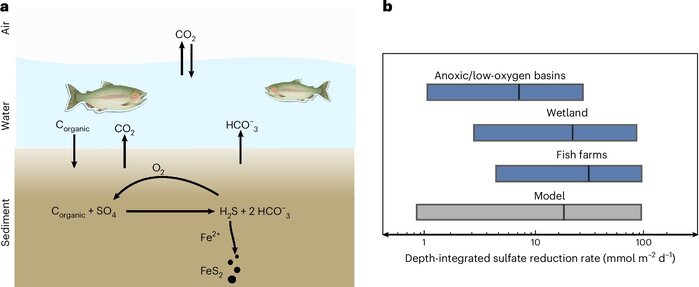
Picture 1: Schematic sedimentary sulfur cycling and modeled rates of sulfate reduction. Credit: Nature Food (2024). DOI: 10.1038/s43016-024-01077-9
LINK
- Pengarah I-AQUAS
- Timbalan Pengarah I-AQUAS
- Ketua Laboratori Ekosistem dan Pengurusan Akuatik
- Ketua Laboratori Akuakultur Mampan
- Web I-AQUAS UPM
- â â Web Universiti Putra Malaysia
- â â Kementerian Pendidikan
- Jabatan Perikanan Malaysia
- Mosti Malaysia
- â Research officer- Mohd Fakhrulddin Ismail
- Research Officer – Dr. Izwaharyanie Ibrahim
- Research Officer – Dr. Nur Hidayahanum Hamid
- Media Sosial I-AQUAS – Tiktok
- Media Sosial I-AQUAS – Twitter
- Media Sosial I-AQUAS – Facebook
- Media Sosial I-AQUAS - Instagram
- Media Sosial I-AQUAS - Youtube
- Google Place
- https://doi.org/10.1038/s43016-024-01077-9
Date of Input: 07/01/2025 | Updated: 31/12/2025 | hidayahanum
MEDIA SHARING