Article prepared by: Dr. Izwaharyanie Ibrahim
Source: Elsevier - Journal of Hazardous Materials
Per- and polyfluoroalkyl substances (PFAS), commonly known as “forever chemicals,” have become a growing global concern due to their persistence in the environment and potential impacts on human health. These synthetic chemicals are highly resistant to natural degradation because of their strong carbon–fluorine bonds, allowing them to remain in water systems for long periods.
While many efforts have focused on controlling long-chain PFAS compounds, newer short-chain PFAS such as perfluorobutanoic acid (PFBA) and perfluorobutane sulfonate (PFBS) are now gaining attention. These compounds were introduced as alternatives to older PFAS; however, their high mobility in water makes them difficult to remove using conventional treatment methods.
Improving PFAS Removal Through Advanced Carbon Materials
Activated carbon and porous carbon materials are among the most widely used technologies for removing PFAS from contaminated water. These materials work by trapping pollutants on their surfaces through a process known as adsorption.
However, the effectiveness of carbon materials depends not only on their pore structure but also on their surface chemistry. Scientists are now exploring ways to modify carbon surfaces to create stronger interactions with PFAS molecules.
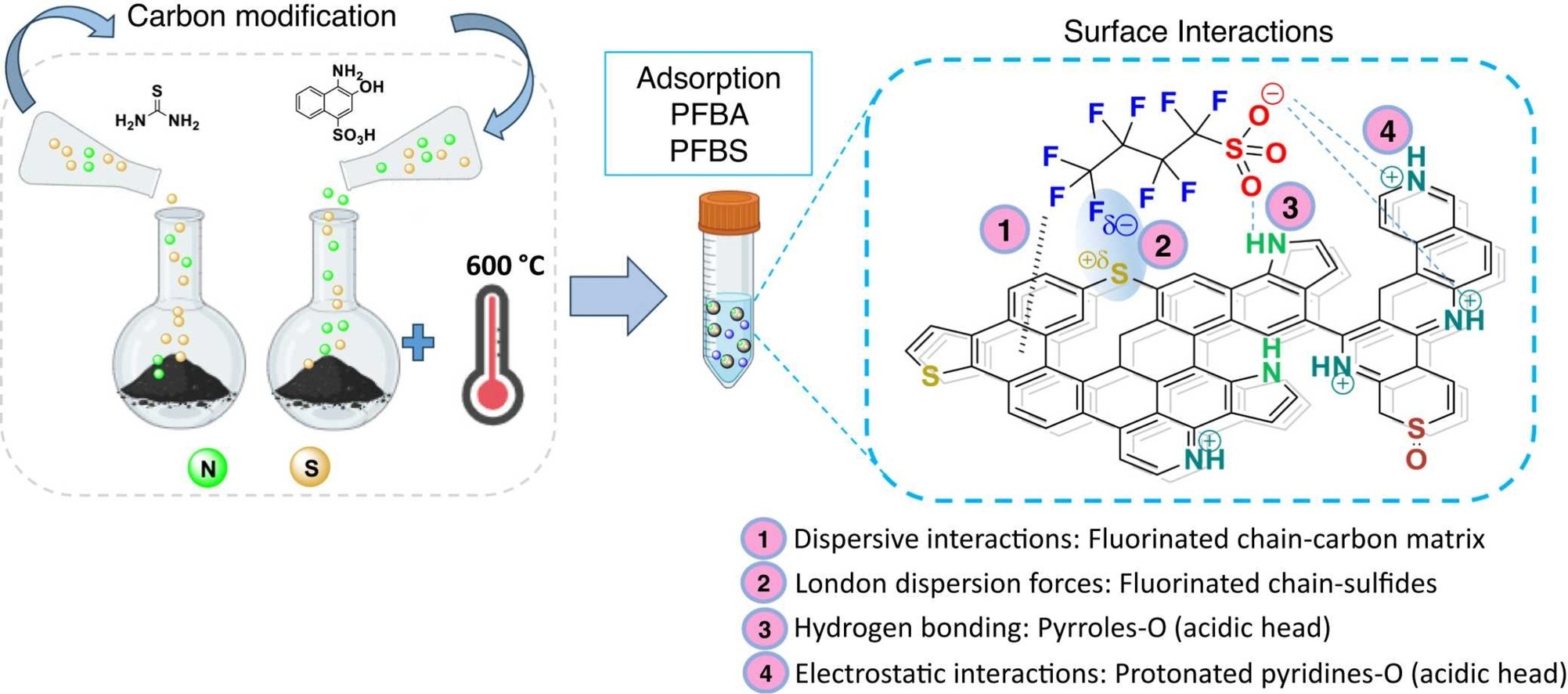
A recent study investigated how adding nitrogen (N) and sulfur (S) functional groups to highly porous carbon could improve its ability to capture short-chain PFAS. Researchers modified carbon materials using chemical treatments that introduced specific surface groups capable of enhancing PFAS adsorption.
How Modified Carbon Captures PFAS
The study revealed that nitrogen and sulfur groups play important roles in attracting PFAS molecules:
- Nitrogen-based groups enhance interactions with the negatively charged parts of PFAS molecules through electrostatic attraction.
- Certain nitrogen structures support hydrogen bonding, strengthening PFAS attachment.
- Sulfur groups interact with fluorinated PFAS chains, improving the capture of these persistent chemicals.
These combined interactions allow modified carbon surfaces to capture PFAS more effectively compared with conventional carbon materials.
Targeting Short-Chain PFAS: A New Challenge
Short-chain PFAS are particularly challenging because their smaller molecular structures allow them to move easily through aquatic environments. The study demonstrated that surface modification could improve carbon’s ability to adsorb these difficult-to-remove compounds.
Among the modified materials tested, carbon treated with sulfur- and nitrogen-containing groups showed improved performance, highlighting the importance of designing adsorbents based on the chemical characteristics of specific pollutants.
Towards Better Water Treatment Solutions
The findings provide valuable insights for developing next-generation water treatment technologies. Instead of relying only on highly porous materials, future approaches can focus on designing “smart” adsorbents with targeted chemical properties.
Such innovations could improve the removal of emerging contaminants and support safer water resources for communities and ecosystems.
Conclusion
PFAS pollution remains a major environmental challenge, particularly as short-chain PFAS continue to spread in water systems. This research highlights that modifying carbon materials with nitrogen and sulfur groups can significantly enhance PFAS adsorption by improving interactions between pollutants and adsorbent surfaces.
Advanced carbon-based technologies represent a promising pathway toward more effective treatment of “forever chemicals” and long-term protection of water quality.
References
- https://doi.org/10.1016/j.jhazmat.2026.141781
- Pengarah I-AQUAS
- Timbalan Pengarah I-AQUAS
- Ketua Laboratori Ekosistem dan Pengurusan Akuatik
- Ketua Laboratori Akuakultur Mampan
- Web I-AQUAS UPM
- Siswazah I-AQUAS
- Web Universiti Putra Malaysia
- Kementerian Pendidikan
- Jabatan Perikanan Malaysia
- Mosti Malaysia
- Research officer- Mohd Fakhrulddin Ismail
- Research Officer – Dr. Izwaharyanie Ibrahim
- Research Officer – Dr. Nur Hidayahanum Hamid
- Media Sosial I-AQUAS – Tiktok
- Media Sosial I-AQUAS – Twitter
- Media Sosial I-AQUAS – Facebook
- Media Sosial I-AQUAS - Instagram
- Media Sosial I-AQUAS - Youtube
- Google Place
Date of Input: 06/07/2026 | Updated: 07/07/2026 | izwaharyanie
MEDIA SHARING