Article by: Nur Hidayahanum Hamid
Source: University of Miami Rosenstiel School of Marine, Atmospheric, and Earth Science (ScienceDaily)
The first global analysis of larval fish orientation reveals that tiny fish larvae, measuring only millimeters, consistently use external cues such as the Sun, Earth's magnetic field, and sounds to navigate the open ocean. Led by scientists at the University of Miami Rosenstiel School of Marine, Atmospheric, and Earth Science, this study provides crucial insights into the early, perilous phase of marine fish life.
Understanding these navigation mechanisms is essential for predicting larval dispersal, the connectivity of marine protected areas, and the structure of marine fish populations. Traditionally thought to be passive drifters relying on ocean currents, fish larvae from various species worldwide can actively control their destination and migrate by maintaining a bearing.
The research analyzed data from nearly two decades of studies using two methods: a Drifting In Situ Chamber, which records larval swimming behavior in natural settings, and the Following method, where scuba divers track late-stage larvae to record their movements. These methods showed that fish larvae use external cues for orientation, supporting the concept of vector-navigation in their early life stages.
This groundbreaking study, supported by a National Science Foundation grant, underscores the importance of understanding larval stages for effective marine population management and conservation. The findings suggest that fish larvae’s navigation skills could enhance fisheries models and underwater navigation science.
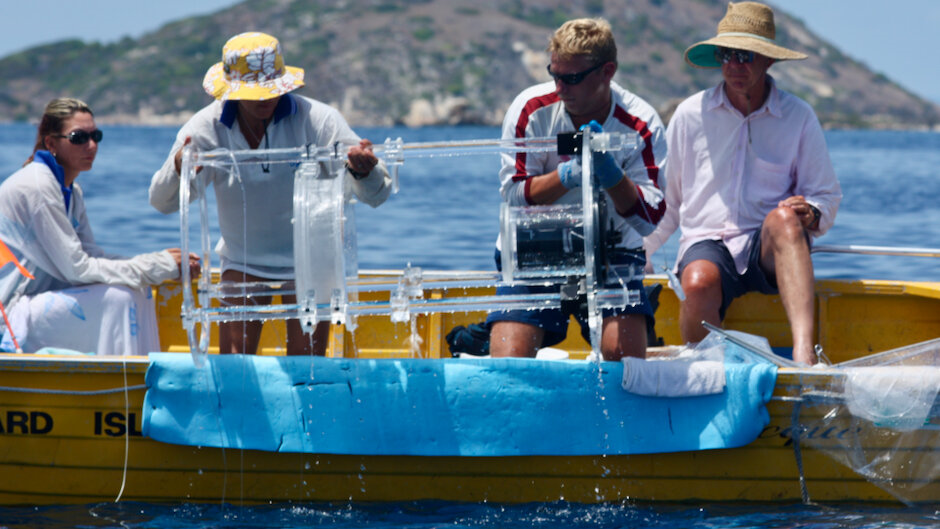
Picture 1: Claire Paris, professor of ocean sciences (center left), and co-author Jean-Olivier Irisson (center right) deploy the Drifting In Situ Chamber (DISC), equipped with an imaging system designed to record larval fish swimming behavior in their natural settings during an expedition at the Australian Museum Lizard Island Research Station. Credit: Lyle Vail
Date of Input: 29/05/2024 | Updated: 07/06/2024 | hidayahanum
MEDIA SHARING