Article prepared by: Dr. Izwaharyanie Ibrahim
Source: Elsevier - Coordination Chemistry Reviews (2026)
An international team of researchers from India and Taiwan has published a comprehensive review on the most promising advanced materials for removing per- and polyfluoroalkyl substances (PFAS) from water. The article, featured in the high-impact journal Coordination Chemistry Reviews, provides a critical evaluation of emerging frameworks like Metal-Organic Frameworks (MOFs), Covalent-Organic Frameworks (COFs), and various carbon nanomaterials, offering a roadmap for future water remediation technologies.
The study, led by Subbaiah Muthu Prabhu and Wei-Lung Tseng, consolidates recent progress in the fight against PFAS, often called "forever chemicals" due to their extreme persistence in the environment and associated health risks. The review is particularly timely, given the recent implementation of stringent drinking water standards by global bodies like the U.S. EPA.
A Rigorous and Systematic Review
The research team undertook a meticulous selection process to identify the most significant studies in the field from 2021 to 2025. As detailed in Figure 1, this workflow involved screening over a hundred records from major scientific databases to distill the 30 most impactful studies focusing on PFAS adsorption. This rigorous approach ensures that the review covers the latest and most effective technologies.
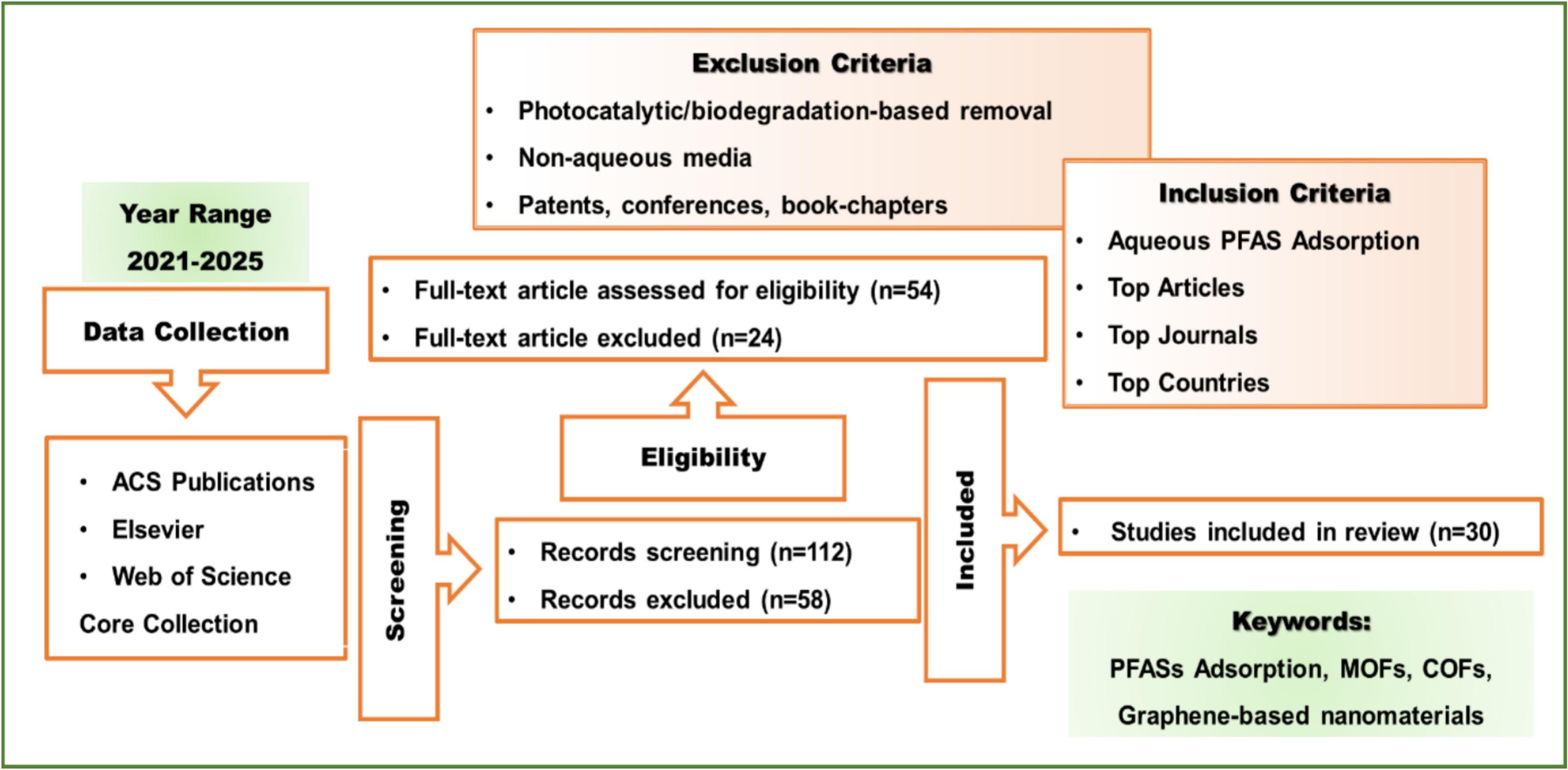
Figure 1- Reproducible workflow for selecting PFAS adsorption study.
Spotlight on Advanced Adsorbents
The review delves into the unique properties of several classes of advanced materials that make them highly effective for capturing PFAS:
i) Metal-Organic Frameworks (MOFs): These materials, such as the widely studied UiO-66, possess highly tunable structures, vast surface areas, and adjustable functional groups. This allows them to be specifically designed to capture different types of PFAS molecules through mechanisms like electrostatic attraction and hydrophobic interactions.
ii) Covalent-Organic Frameworks (COFs): Similar to MOFs, COFs offer crystalline, porous structures that can be tailored for selective PFAS adsorption.
iii) Graphene and Carbon-Based Nanomaterials: Materials like graphene oxide (GO) and activated carbon excel at PFAS adsorption due to their large surface areas and strong interactions with PFAS molecules.
Figure 2 illustrates a specific example highlighted in the review: the development of a MOF-based composite (PVA@UiO-66-NHâ‚‚/GO). The figure shows the synthesis process and uses advanced computer simulations (Ab Initio Molecular Dynamics) to visualize how PFAS molecules like PFOA interact with the adsorbent at a molecular level.
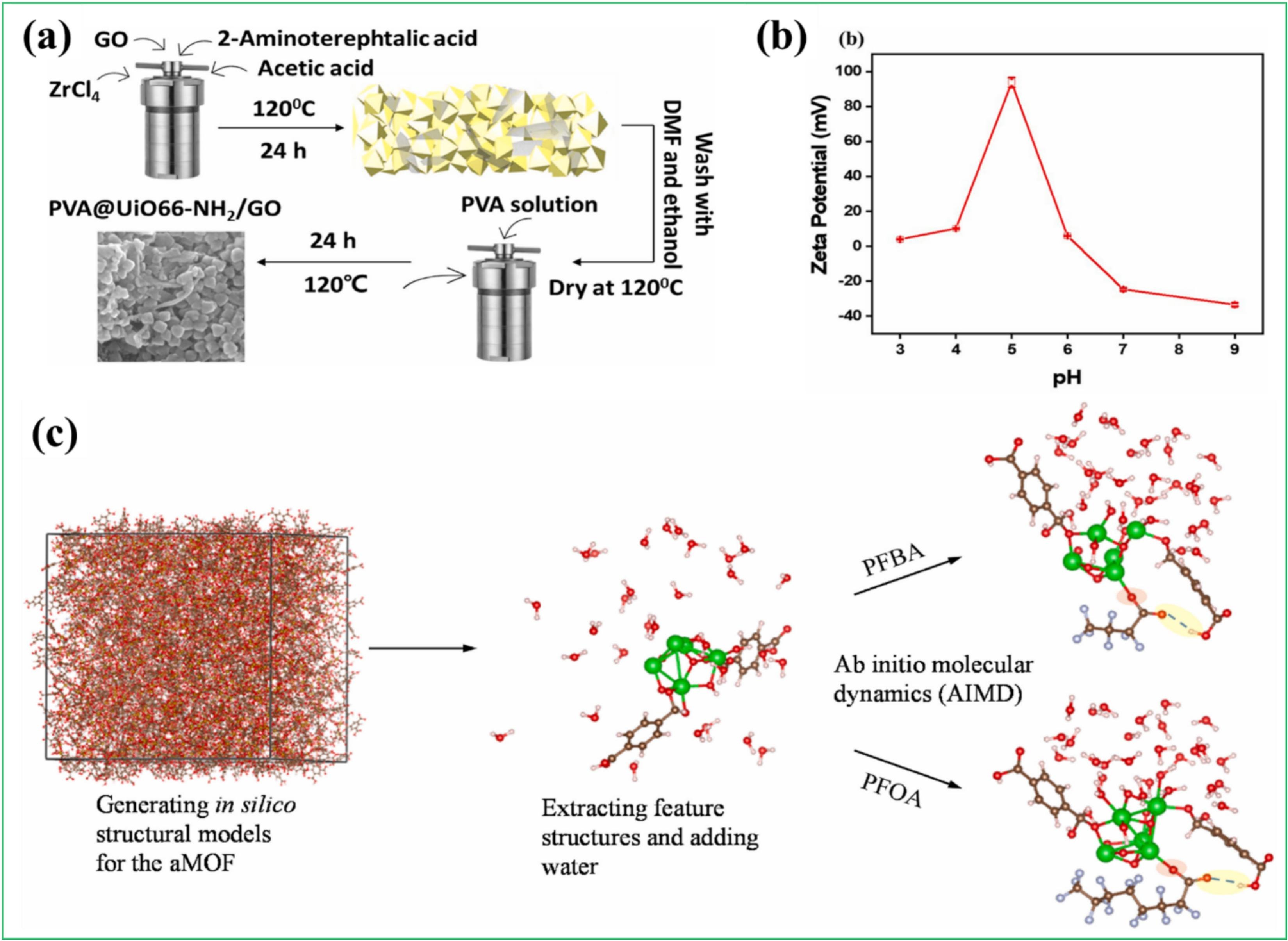
Figure 2- (a) Development of UiO-66-NHâ‚‚ MOF-based composite using a solvothermal method and their (d) Zeta potential in each pH. (c) Ab initio molecular dynamics (AIMD) simulations of perfluorocarboxylic acids adsorption on amorphous UiO-66.
Future Directions for Clean Water
The review concludes by identifying key knowledge gaps and outlining future research directions. The authors emphasize the need to develop sustainable, high-efficiency adsorbents that can remove a broad range of PFAS from real-world water systems. They also call for a greater focus on regeneration feasibility, scalability, and the integration of these advanced materials into existing water treatment infrastructure.
This comprehensive analysis serves as a vital resource for scientists and engineers working to solve the global challenge of PFAS contamination, paving the way for the next generation of water purification technologies.
References
- https://doi.org/10.1016/j.ccr.2025.217560
- Pengarah I-AQUAS
- Timbalan Pengarah I-AQUAS
- Ketua Laboratori Ekosistem dan Pengurusan Akuatik
- Ketua Laboratori Akuakultur Mampan
- Web I-AQUAS UPM
- Siswazah I-AQUAS
- â â Web Universiti Putra Malaysia
- â â Kementerian Pendidikan
- Jabatan Perikanan Malaysia
- Mosti Malaysia
- â Research officer- Mohd Fakhrulddin Ismail
- Research Officer – Dr. Izwaharyanie Ibrahim
- Research Officer – Dr. Nur Hidayahanum Hamid
- Media Sosial I-AQUAS – Tiktok
- Media Sosial I-AQUAS – Twitter
- Media Sosial I-AQUAS – Facebook
- Media Sosial I-AQUAS - Instagram
- Media Sosial I-AQUAS - Youtube
- Google Place
Date of Input: 20/01/2026 | Updated: 30/01/2026 | izwaharyanie
MEDIA SHARING