Article by: Izwaharyanie Ibrahim
Source: Biosensors and Bioelectronics (Elsevier)
A Breakthrough in Metal Ion Detection
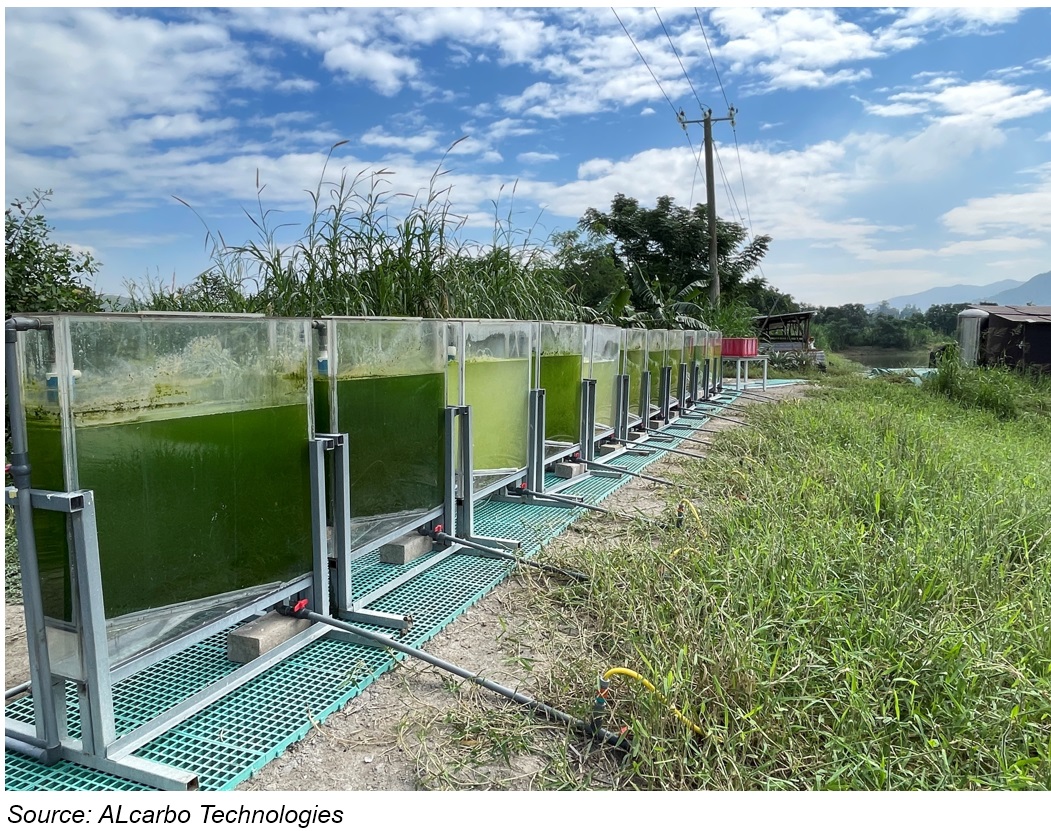
Water contamination by heavy metal ions poses a serious threat to human health and ecosystems. Traditional detection methods are often complex, costly, and time-consuming. To address this challenge, researchers have developed a microalgae-based living sensor, offering a faster, more sensitive, and eco-friendly solution.
How Does the Microalgae Sensor Work?
This sensor utilizes Chlorella sp. microalgae, which generates a small electric current through bio-photovoltaic processes. To enhance sensitivity, researchers introduced copper (Cu) nanocavities, which amplify the photoelectrochemical response. When exposed to violet light, the microalgae's energy interacts with the nanocavities, significantly boosting the detected electrical signal.
Highly Sensitive Metal Ion Detection
Lab tests have shown that this sensor can detect metal ions at ultra-low levels (50 nM), far surpassing conventional detection methods. It is effective for detecting various heavy and light metal ions, including cadmium, iron, chromium, and manganese, which are major contaminants in water sources.
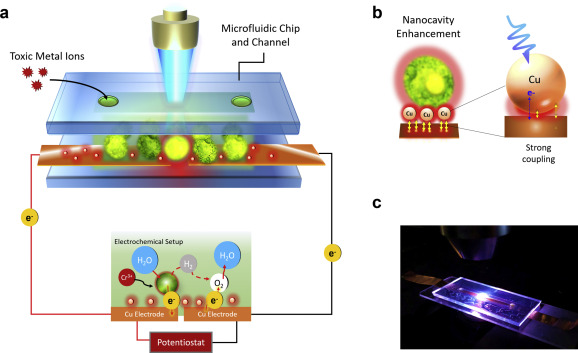
Figure 1. Schematic illustration of the photosynthetic microalgae biosensor with nanocavity. (a) A microfluidic chip designed with a copper tape bottom layer is injected with Chlorella sp. and excited with violet light. Metal ions can then be injected into the device. The bottom panel shows the split copper tape electrodes to harvest electrons from Chlorella sp. (b) Concept of Fabry-Perot like nanocavity formed between nanoparticles and copper film beneath. The microalgae will absorb the reflected and scattered fluorescence emission. Strong plasmon coupling is also expected to form hotspots when the CuNPs are closely adhered to the electrode surface, therefore enhancing the photocurrents. (c) Photo of the sensing device in which Chlorella sp. are being excited by violet light.
Applications in Water Quality Monitoring
With high detection sensitivity and fast response time, this microalgae sensor has potential applications in:
- Real-time water quality monitoring at water treatment plants and industrial sites.
- Early warning systems for heavy metal pollution in rivers and lakes.
- Sustainable biofuel and optoelectronic applications.
Conclusion
The development of this microalgae-based living sensor represents a significant step forward in water quality monitoring, offering a biologically driven, highly sensitive, and sustainable solution for environmental protection. This innovation could revolutionize how we detect and control water pollution, ensuring safer water resources for future generations.
For more information on the study and its implications, you can access the full research paper here:
https://www.sciencedirect.com/science/article/pii/S0956566320304140
Date of Input: 13/03/2025 | Updated: 20/08/2026 | izwaharyanie
MEDIA SHARING